Outlook exports OST emails to a PST file with the Import and Export wizard. Four methods extract the emails and three of them are free and use only Outlook. Free methods need the original account in Outlook and cannot open an orphaned or corrupt file. Converter software opens those files and exports the emails to PST, MSG, EML or MBOX. Export one folder first and compare the emails with the preview.
Outlook stores a copy of your mailbox in an OST file but you cannot open that file like a PST file to extract email from OST. Emails appear only while the source account is connected.
This guide explains OST files, free methods to extract email from OST, a dedicated tool for orphaned and corrupt files and problems you face during the export of OST emails.
What Does an OST File Store?
OST files store a copy of the mailbox items that live on a mail server. Exchange accounts and accounts that work offline create an OST file in Outlook. OST stands for Offline Storage Table.
- Server Copy. Microsoft states that OST files are always copies of items saved on a mail server so the server stores the original emails.
- Account Link. Outlook shows the emails only through the original account of the file.
- Orphaned File. An OST file becomes orphaned when its account is deleted or the mailbox is unreachable. Outlook cannot open an orphaned file.
- Cached Items. Cached Exchange Mode stores a part of the mailbox in the file and Microsoft lists 12 months as the default.
PST files store the items you move into them and open in any Outlook profile. OST files open only through their own account. Our guide to Exchange OST File Orphaned Reasons and Recovery explains how a file loses its account.
What to Check Before You Extract Emails From an OST File?
Before extracting emails from an OST file, make sure to:
- Copy the OST file into a backup folder. Our guide to Search OST File on Your Computer shows where Outlook stores it.
- Close Outlook before you copy the file.
- Open classic Outlook for Windows because the Microsoft export steps below are for classic Outlook.
- Check the free disk space because the PST file needs room for every exported email.
Which Free Methods Extract Emails From Outlook OST Files?
Three free methods use only Outlook. Every method needs an Outlook profile with the original account of the OST file.
Export Emails to PST With Import and Export (Free, Windows)
Import and Export saves the emails of one account in a PST file. Microsoft documents the wizard in the Microsoft PST Export Steps. Outlook exports one account at a time.
- Open the Outlook profile of the OST account.
- Click File, select Open & Export and click Import/Export.
- Select Export to a file and click Next. Click Outlook Data File (.pst) on the next screen and click Next.
- Select the account or the folder to export and tick Include subfolders. Click Next.
- Click Browse, select a folder and enter a file name. Click OK.
- Select an option for duplicate items when the PST file already exists. Click Finish.
Microsoft states that Outlook exports attachments with the emails and that your original data remains in Outlook.
Cached Exchange Mode exports only the cached items. Open Account Settings, select Account Name and Sync Settings and move the slider to All before you export older emails. Do not save the PST file in a OneDrive folder because OneDrive does not sync PST files automatically.
Archive Emails to PST by Date (Free, Windows)
Archive saves the emails older than a date in a PST file. Microsoft states that the command can be missing when your organization uses Exchange Online Archive and that an administrator can disable it. Open the Microsoft Archive Steps for the full path.
- Click File, select Info, select Tools and click Clean up old items.
- Select Archive this folder and all subfolders and select the folder.
- Enter a date under Archive items older than.
- Check the Archive file path and click Browse to select another folder.
- Click OK.
Archive selects emails by date so items newer than your date are not in the PST file.
Copy Emails to a New PST File (Free, Few Folders)
Copy Folder suits a few folders. Every extra folder adds one more copy action.
- Click Home, select New Items, select More Items and click Outlook Data File.
- Enter a file name and click OK. Outlook shows the new file in the folder pane.
- Right click a folder in the OST mailbox and select Copy Folder.
- Select the new data file and click OK.
- Repeat steps 3 and 4 for the other folders.
How to Extract Emails From OST Files With EmailDoctor OST Converter?
EmailDoctor software opens an OST file without its original account. Export emails from a corrupt or orphaned OST file to PST and other formats.
Free version previews the OST items and converts 25 items per folder. Full version converts every item. Use the software to extract email from an orphaned OST file.
Seven features matter for an OST file.
- No Account Needed. Conversion needs no Exchange profile and no IMAP server connection.
- Quick and Advance Scan. Quick scan suits a healthy file while Advance scan suits a highly corrupted file.
- Preview Modes. Open an email in Normal Mail View, Properties, Message Header, MIME, HTML, RTF, Attachments or Hex.
- Deleted Items. The preview shows deleted emails in red.
- Export Filters. Adv. Settings splits the PST file and sets a date range or the categories Mails, Contacts, Calendars, Tasks, Notes and Journals.
- Batch Export. Search File finds OST files on your computer so you export several files together.
- Export Formats. Export to PST, MBOX, MSG, EML, EMLX, NSF, PDF, vCard, CSV, ICS, TXT, HTML, MHT and document formats.
Match your computer to the requirements below.
- Operating System. Windows 11, 10, 8, 7 and Windows Server 2025, 2022, 2019, 2016, 2012 R2 or 2008.
- Outlook Versions. Compatible with Outlook 2000 to 2024 in 32 bit or 64 bit.
- Disk Space. Installation needs 100 MB of free space.
- Memory. Recommended memory is 4 GB.
- .NET Framework. Microsoft .NET Framework 4.5 or higher is required.
Add the OST File
- Start the converter from the Start menu.

- Click Add File at the top left of the window.

- Select Select File and click the browse button next to OST File. Select Search File instead when you do not know the location.

- Browse to the OST file, select it and click Open.

- Select Quick for a healthy file or Advance for a corrupted file under Scan Mode. Tick Remove Encryption when the emails use S/MIME or OpenPGP encryption. Click Add.

Scan and Preview the Emails
- Wait while the converter scans the OST file.

- Click Yes to save the scan so a rescan is faster.

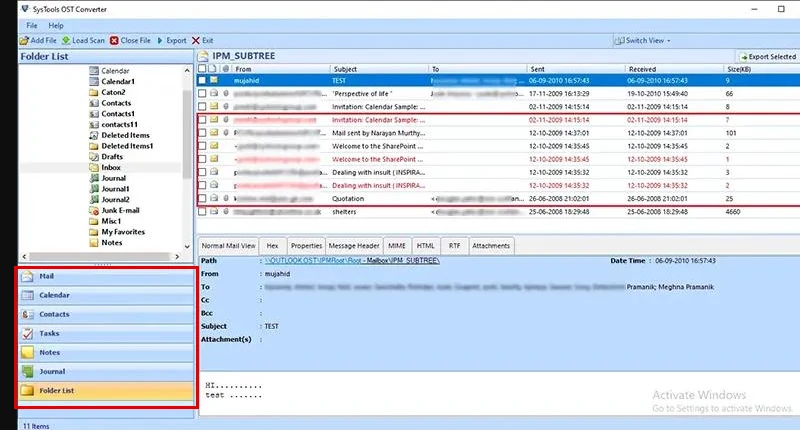
- Click a folder in the left panel. Folders in bold contain data.

- Click an email and open a preview mode under the email list. Deleted emails appear in red.

- Click Mail, Calendars, Contacts, Tasks, Notes or Journals at the bottom left to preview the other items.
Export the Emails to PST
- Click Export in the top toolbar to export every item. Tick items and click Export Selected to export only those.

- Select PST under Select Export Type. Click Adv. Settings for more options.

- Set the PST split size, a date range or the categories in Adv. Settings. Click Save.

- Click Browse and select a destination folder. Tick Maintain Folder Hierarchy to retain the folder structure and click Export.

- Wait while the converter exports the emails.

- Click OK after the converter finishes the export.

- Check the Success Count and the Fail Count in the export report. Open the PST file in Outlook with File, Open & Export and Open Outlook Data File.

Compare the exported emails with the preview before you delete the OST file or its account.
Which Method Suits Your OST File?
Extracting emails from OST files ends in a PST file with all four methods but the methods differ in the files they open.
| Feature | Import and Export | Archive | Copy Folder | Converter Software |
|---|---|---|---|---|
| Needs the original account in Outlook | Yes | Yes | Yes | No |
| Opens orphaned and corrupted OST files | No | No | No | Yes |
| Preview before the export | Outlook folders | Outlook folders | Outlook folders | Eight preview modes |
| Output formats | PST | PST | PST | PST, MBOX, MSG, EML and more |
| Price | Free | Free | Free | Free demo with a paid full version |
Use Import and Export when Outlook still opens the account. Use Archive for emails older than a date and Copy Folder for a few folders. Use converter software for an orphaned or corrupt file or when you need a format other than PST.
What Problems Appear When You Export OST Emails?
Six problems appear when you extract emails from an Outlook OST file.
- Outlook Cannot Open the OST File. Its original account is deleted or disconnected. Use converter software or follow the guide to open a corrupt OST file.
- Export Menu Is Missing. Microsoft documents the export steps for classic Outlook for Windows. Switch from new Outlook to classic Outlook and open the File menu.
- Older Emails Are Missing. Cached Exchange Mode exports only the cached items. Move the sync slider to All before the export.
- Archive Command Is Missing. Exchange Online Archive or an administrator setting hides the command. Use Import and Export instead.
- Corrupted OST File. Outlook shows errors or stops while it opens the file. Select Advance scan in the converter.
- Free Version Stops at 25 Items. Free version limits the export to 25 items in every folder. Upgrade to the full version for every item.
Our guide to Access OST File Without Exchange explains more options for an OST file without its server.
Frequently Asked Questions
Can I Get Emails Out of an OST File Without Outlook?
Yes. Converter software opens the file without an Outlook profile. Conversion needs no Exchange profile and no IMAP server connection.
Can Outlook Open an OST File From Another Computer?
No. Outlook opens the OST data only through its original account. Use converter software for a file from another computer.
Does Export to PST Remove Emails From the OST File?
No. Microsoft states that Outlook exports a copy and your original data remains in Outlook.
Can I Extract Only Emails and Not Contacts?
Yes. Select only the Inbox folder in the export wizard and clear Include subfolders. Select the categories under Adv. Settings in the software.
Can I Extract Contacts and Calendars From an OST File?
Yes. Microsoft states that the export wizard includes the Inbox, Calendar, Contacts and Tasks folders with Include subfolders. Our guides explain how to extract contacts from OST files and how to extract a calendar from OST files.
Is There a Size Limit for the Exported PST File?
Yes. Microsoft lists 50 GB as the default maximum for Unicode PST and OST files in Outlook 2010 and later. Split the PST file in Adv. Settings when the mailbox is larger. Microsoft explains the limit in its Outlook data file size limit guide.
Does the Free Version Extract Emails?
Yes. Free version previews the OST items and exports 25 items from a folder. Full version exports every item.
Can the Software Open a Corrupted OST File?
Yes. Select Advance under Scan Mode for a highly corrupted file.
Can I Delete the OST File After the Export?
Yes when the account still connects. Microsoft states that OST files are always copies of items saved on a mail server so the server stores the original emails. Compare the exported PST file with the preview first when the account is deleted or disconnected.
Can I Convert Several OST Files Together?
Yes. Select Search File to find the OST files on your computer and add them. The software creates a separate result for every OST file.
Which Windows Editions Work With the Software?
Windows 11, 10, 8 and 7 and Windows Server 2008 to 2025 are compatible. Install Microsoft .NET Framework 4.5 or higher first.
Final Words
Outlook opens an OST file only through the original account because the file is a server copy. You extract email from an Outlook OST file with Import and Export when that account still connects. Converter software opens orphaned and corrupt files.
Copy the OST file into a backup folder before you start and test one folder first. EmailDoctor software previews every email before the export.
- Four methods exist to extract emails from OST mailboxes.
- Import and Export, Archive and Copy Folder need the original account in Outlook.
- Cached Exchange Mode limits an export to the cached items.
- Converter software opens orphaned and corrupted files and exports to PST, MBOX, MSG and EML.
- Free version exports 25 items from a folder.
Next Read: Convert OST to PST
Also Read: Import OST to Outlook | Recover Data for MS Exchange OST Files