Outlook does not natively allow importing MBOX files directly; it strictly uses the proprietary PST data format. To effectively import MBOX files to Outlook, use a professional MBOX to PST converter tool such as EmailDoctor:
- Convert the file: Open the software >> convert the MBOX file to PST for Outlook.
- Open Outlook: Go to File >> Open & Export >> Import/Export.
- Import: Select “Import from another program or file” >> choose the “Outlook Data File (.pst)” file >> select the newly converted .pst file.
- Finish: Choose the destination folder >> click “Finish”.
Can Microsoft Outlook Open MBOX Files Directly?
The direct answer is no! Microsoft Outlook cannot open, read, or import MBOX files directly. Outlook strictly utilizes its own proprietary data file format:
- PST (Personal Storage Table): For local archives
- OST (Offline Storage Table): For cached Exchange data.
The native Outlook Import/Export wizard doesn’t provide an MBOX option. Also, if an .mbox file is dragged and dropped directly into the Outlook interface, the application will simply discard the file. Or attach it as an unreadable file to an empty email.
Due to this hard architectural limitation or incompatibility, a “direct” import of MBOX files into Outlook is technically not feasible. Hence, .mbox files must be converted to .pst to import & access MBOX data in Outlook.
But why does a direct import fail, and why is conversion necessary?
MBOX vs PST: Why Conversion Is Necessary
MBOX to PST conversion is necessary because the two file formats are fundamentally different at the database level.
When an MBOX file is attempted to be imported directly into Outlook, Outlook initiates locating MAPI database tables (like index pointers and folder hierarchy maps). It finds flat, unreadable text only.
Therefore, converting MBOX files to PST format is not merely a format change. It is a process of extracting the raw data from the flat MIME string. And inserting it into the structure of MAPI databases (that Outlook needs to operate).
For your better understanding of both formats at the database level, here is the side-by-side comparison of MBOX and PST file formats:
| Feature | MBOX | PST |
|---|---|---|
| File Format | Text-Based mailbox format | Outlook proprietary data file format |
| Commonly used by | Thunderbird, Apple Mail, Google Takeout | Microsoft Outlook |
| Outlook Compatibility | No native MBOX support | Supported; features vary by Outlook version |
| Data Organization | Saves messages from a single mailbox folder | Can store multiple folders and Outlook item types (In Bulk) |
| Direct Outlook Import | Not Supported | Supported in classic Outlook and eligible new Outlook configurations |
4 Best Methods to Import MBOX Files to Outlook
There are four effective and verified methods available for moving MBOX data into Microsoft Outlook:
- Automated MBOX to PST Conversion
- Manual IMAP Synchronization
- EML Drag-and-Drop
- Native Outlook for Mac Import
Choose the method that best fits your operating system, archive size, and compliance requirements. Here is the side-by-side comparison of all four methods based purely on critical enterprise migration parameters:
| Feature/Risk | Automated MBOX to PST (EmailDoctor) | Manual IMAP | EML Drag-and-Drop | Native Outlook for Mac Import |
|---|---|---|---|---|
| Data Preservation | Emails and attachments show in a preview before the export | Depends on the Gmail sync | Medium (preserves individual email metadata) | Same as the PST or OLM file you import |
| Operational Efficiency | Local conversion without internet | Slow (depends on internet upload and download speed) | Very low (manual, one-by-one extraction process) | Medium (needs an extra conversion to PST or OLM) |
| Folder Hierarchy | Kept with the Maintain Folder Hierarchy option | Gmail labels become folders | Folders need to be rebuilt manually | Kept from the imported file |
| Handling Large Files | Split PST option divides the output | Slow sync and 15 GB free Google storage | One file per email for small folders | Large archives need a split PST file |
| Technical Expertise | Guided steps in the software window | Needs IMAP server settings and a mail client | Needs Thunderbird and ImportExportTools NG | Low (menu path File > Import) |
Copy your MBOX files first and work on the copies. Outlook never edits your MBOX file during an import so keep the original until every folder opens correctly.
Outlook 2010 and newer preconfigure a 50 GB PST limit and Outlook 2007 and 2003 use 20 GB. Microsoft explains the PST and OST size limits and the registry value that sets them.
Method #1: Automated MBOX to PST Conversion (EmailDoctor)
EmailDoctor Software creates Unicode PST files from MBOX files and works without Outlook installed. Use it to convert MBOX to PST for Outlook and transfer MBOX emails to Outlook in one pass. Windows and Mac editions are available and both export the same PST format.
Six features cover sources, preview, merge, split, filters and conversion without Outlook.
- Email Clients. Add MBOX files from Thunderbird, Entourage, Eudora, SeaMonkey and more.
- Preview. Check emails and attachments before you export.
- Single PST. Merge all selected MBOX files into one PST or create one PST for every file.
- Split PST. Break the output into smaller PST files of a size you choose.
- Date Filter. Convert emails from a chosen date range only.
- No Outlook Needed. Convert MBOX files on a PC that has no Outlook installed.
Create PST Files on Windows
- Install EmailDoctor Software and open its main window.

- Click Add File.

- Select Select file(s)/folder from file system and click Next.

- Click the ... button and browse to your MBOX file. Tick Use Folder Mode and browse to a folder when you have many files.

- Select your file and click Open. Click OK after you select a folder in Folder Mode.

- Click Process to scan the MBOX data.

- Open the Folder List and click a folder to see its emails. Click an email to preview it with attachments.

- Click Export on the top menu to convert all folders. Tick emails and click Export Selected to convert only those.

- Check all mailboxes to export every MBOX file or check particular folders. Select the PST radio button.

- Click Adv. Settings.

- Select Split PST to divide the output into smaller files. Apply the Date Filter to convert one period only.

- Click Save.

- Click Browse to set the destination folder.

- Keep Maintain Folder Hierarchy ticked. Tick Create Single PST for all MBOX files to merge them or keep it unticked for one PST per file. Click Export.

- Watch the export window and click OK when the completion message appears.

- Click Open Location to find your PST files. Open the Export Report to see every converted item.

Import the PST File Into Outlook on Windows
- Open Outlook and click File > Open & Export > Import/Export.
- Select Import from another program or file and click Next.
- Select Outlook Data File (.pst) and click Next.
- Browse to your converted PST file. Under Options choose how Outlook handles duplicate items and click Next.
- Enter the password if the file has one. Choose Import items into the current folder or select your Microsoft 365 mailbox. Click Finish.
New Outlook for Windows imports PST files from Settings > Data files > Import. Select Get started under Outlook Data File (.pst) and then Select file. Choose the folder and the duplicate option and select your mailbox. Click Import.
Convert one small MBOX folder first and import it into Outlook. Test with the free demo because it converts 25 items per folder.
Need to add several converted files? See how to Add Multiple PST Files to Outlook at Once.
EmailDoctor Software also works on macOS and exports PST files. Method #4 below imports that PST file into Outlook for Mac.
Create PST Files on Mac
- Install EmailDoctor Software on your Mac and open it.

- Click Add File(s) for one or many MBOX files or Add Folder(s) for a folder. Click Open or Choose.

- Confirm the file path and size shown and click Next.

- Select the PST radio button. Keep Maintain Folder Hierarchy on and tick the MBOX folders you want to convert.

- Click Advance Settings for Create Single PST, Split PST and Date Filters. Click Save.

- Click Change and choose the destination folder.

- Click Export and watch the Mail and Fail Count in the export window.

- Click OK when the confirmation box appears. Click View Report to open the Export Report folder with a CSV file.

- Open the destination folder to find your PST files. One merged PST file appears when you choose Create Single PST.

Keep the attach folder beside the .mbx file when you convert Eudora or Pocomail emails with attachments. Eudora and Pocomail store attachments in a separate folder.
Method #2: Manual IMAP Synchronization
IMAP keeps a mailbox on a server and shows the same folders in every email client. Copy your MBOX emails into a Gmail account from Thunderbird and Outlook syncs them down. This Thunderbird MBOX to Outlook transfer costs nothing but takes time.
Copy MBOX Emails Into Gmail
- Open Thunderbird and enter your Gmail address in the account setup window. Sign in through the Google window.
- Select Configure Manually if auto setup fails and enter the server details from the table below.
| Protocol | Server | Port | Encryption |
|---|---|---|---|
| IMAP | imap.gmail.com | 993 | SSL |
| SMTP | smtp.gmail.com | 587 | TLS |
- Import your MBOX file into Local Folders with ImportExportTools NG as shown in the earlier route.
- Create a folder in the Gmail account. Press Ctrl+A to mark all emails. Use the context menu to choose Copy to and select the Gmail folder.
- Wait until Thunderbird finishes syncing and then open Gmail in a browser to check the emails.
Add Gmail to Outlook
- Open Outlook and click File > Add Account.
- Enter your Gmail address and click Connect. Sign in through the Google window.
- Wait for the Gmail folders to download. Drag emails into an Outlook Data File folder if you want local copies.
Free Google accounts share 15 GB across Gmail, Drive and Photos. Google Workspace admins must switch on IMAP and Google requires OAuth sign in for third party clients on Workspace accounts. See Google Workspace Admin Help for the settings.
Emails reach Outlook only after Outlook and Gmail finish syncing so large folders take time.
Method #3: EML Drag-and-Drop
Thunderbird opens MBOX files and the ImportExportTools NG extension saves emails as EML files. Use this method when you open MBOX files in Outlook as single emails. Outlook accepts EML files by drag and drop. You need Thunderbird and Outlook on the same PC.
Export MBOX Emails as EML Files
- Install Thunderbird and open the Tools menu. Select Add-ons and Themes.
- Look up ImportExportTools NG in the search box and install it. Restart Thunderbird afterwards.
- Choose ImportExportTools NG > Import mbox file from the Local Folders context menu.
- Choose your MBOX file in the dialog and confirm with Open.
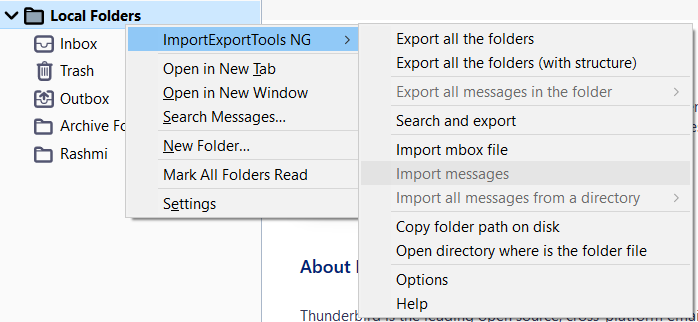
- Open the context menu of the imported folder and select ImportExportTools NG > Export all messages in the folder > EML format.
- Choose a destination folder on your PC.
Drag EML Files Into Outlook
- Open Outlook. Go to the Folder tab and click New Folder. Name it after your MBOX file.
- Open the export folder in File Explorer and select all EML files with Ctrl+A. Drop them onto the new Outlook folder.
- Open a few emails and check the dates and attachments.
EML export creates one file for every email. Test a small folder first and check dates and attachments before you export everything.
Need EML files without Thunderbird? See how to Convert MBOX to EML directly. Our EML Files to Outlook guide covers the Outlook side in more depth.
Name the Outlook folder after the MBOX file. Several imports then sort into clear folders.
Method #4: Native Outlook for Mac Import
Outlook for Mac has its own File > Import command and it has no MBOX option. A Microsoft support answer states that importing an MBOX file straight into Outlook for Mac is not feasible. Convert the MBOX file to PST with the Mac edition from Method #1 first.
- Open Outlook for Mac and select File > Import.
- Select Outlook for Windows archive file (.pst) and click Continue.
- Find your PST file and click Import. Click Finish when the process ends. Imported items appear under On My Computer.
Microsoft documents this path for legacy Outlook for Mac. Menus look different in newer Outlook for Mac builds.
Using Apple Mail? See how to Import and Export MBOX in Apple Mail too.
Troubleshooting Common MBOX-to-Outlook Import Problems
Four problems come up with these methods.
- Extension Not Working. Install ImportExportTools NG again and see Thunderbird ImportExportTools NG Not Working Issue.
- MBOX File Too Large. Break large files with Split MBOX File before you convert.
- PST Reaches Its Limit. Outlook 2010 and newer preconfigure 50 GB. Use Split PST or see Outlook PST File Is Too Large.
- Gmail Sign In Fails. Workspace accounts need an admin who switched on IMAP and an OAuth sign in.
Frequently Asked Questions
Common questions about moving MBOX emails into Outlook are answered below.
Can Outlook Open MBOX Files Directly?
No. Outlook uses PST files and server mailboxes. Move MBOX emails through EML files or Gmail IMAP or convert them to PST.
Is There a Free Way to Bring MBOX Mail Into Outlook?
Thunderbird with ImportExportTools NG and a Gmail IMAP account cost nothing. Both need manual work and suit small folders.
Can I Convert MBOX to PST Without Outlook?
Yes. EmailDoctor Software creates Unicode PST files on a PC without Outlook. Outlook is needed only for the final import.
Does Outlook for Mac Open MBOX Files?
No. Outlook for Mac imports PST and OLM files only. Use the Mac edition to create a PST file and import it through File > Import.
Can I Merge Many MBOX Files Into One PST?
Yes. Tick Create Single PST for all MBOX files before you click Export. Keep it unticked for one PST file per MBOX file.
Can I Import MBOX Emails From One Date Range?
Use the Date Filter under Adv. Settings on Windows or Advance Settings on Mac to convert emails from one period.
What PST Size Does Outlook Accept?
Outlook 2010 and newer preconfigure 50 GB while Outlook 2007 and 2003 use 20 GB. Use Split PST to break large output into smaller files.
Can I Import a Google Takeout MBOX File to Outlook?
Google Takeout exports Gmail data as MBOX and the methods above accept it. See Google Takeout to Outlook PST Conversion for that flow.
Does Outlook Keep My MBOX Folder Structure?
EmailDoctor Software keeps Maintain Folder Hierarchy ticked by default so folders appear in the PST file as they were in the MBOX source.
Author’s Verdict
Outlook has no MBOX import so every method needs a bridge. Thunderbird and Gmail IMAP cost nothing and suit small folders.
I suggest EmailDoctor for larger archives on Windows and Mac because PST files import in one pass and you control the size and date range. Test one small folder before you convert the rest. EmailDoctor also merges multiple MBOX files into one PST for Outlook when you tick Create Single PST for all MBOX files.
Do you plan Outlook or Microsoft 365 mailboxes? For an MBOX to Outlook 365 migration see how to import MBOX to Office 365.
- Outlook cannot open MBOX files.
- EmailDoctor converts MBOX to PST on Windows and Mac and Outlook imports the PST file.
- Gmail IMAP syncs emails to Outlook and Thunderbird saves EML copies for drag and drop.
- Outlook for Mac imports PST files and has no MBOX option.
Next Read: Import and Export MBOX in Apple Mail
Also Read: Import MBOX to Office 365 | MBOX to PST Converter